There's something about Himalayan food that just sticks with you. Rich and aromatic, the kind of meal you're still thinking about the next day. So, what's actually going on there? It's not the recipe alone. It's the spices. Families across India, Nepal, and the wider Himalayan belt have been passing down the same spice combinations for generations, and honestly, that's where the depth comes from.
Take Timur, citrusy, with this odd little tingle on the tongue. Or black cardamom, smoky and a bit sweet. Or turmeric, warm and earthy. None of them do the same job, but stacked together, that’s the bold flavor Himalayan food is known for.
A lot of these spices aren’t exotic and are even available in Richardson. Spices like turmeric, coriander, black pepper, and cardamom are available in Walmart or Costco. But there’s an old saying: “even imitation requires skill.” Owning the spice rack doesn’t mean you’ll pull off the flavor. The technique is really where it happens.
So, in this guide, we’ll learn about the essential Himalayan spices and show you how they come together to build the flavors Himalayan cuisines are famous for.
Many folks might not know about Timur, but you just need to try it once to remember it forever. It comes from a small tree and smells like citrus. But what makes it unique is not its smell; it’s its taste. Timur leaves a light buzz, or a tingling feel on your tongue.
Cooks in Nepal use Timur a lot to add a fresh kick to soups and a fresh kick to meat too.
You may know Sichuan pepper; it’s very common in Chinese food and is also used in many Himalayan dishes. This spice isn't hot or spicy, but it leaves a tingling, electric, and numbing feeling on your tongue.
This spice comes from a tiny, dried fruit, and many people cook and grind it fresh to have the best taste.
Turmeric is one of the first spices many people notice. Its bright golden color stands out in any dish and comes from the root of a plant, much like ginger. Once dried and ground, it becomes the rich yellow powder found in many Himalayan kitchens.
People across Nepal and India use turmeric every day to give food its beautiful golden color. It is commonly used in curries, lentils, and vegetables to bring a warm, earthy flavor.
Cumin is the most common ingredient in every Indian and Nepali dish. It may look small, but it has a big flavor. The tiny brown seeds have a warm, nutty taste with a hint of smokiness. Most cooks lightly toast the seeds before using them to bring out their rich aroma.
It is mostly used in soups, rice, curries, and meat recipes to add depth. Ground or whole, it is a spice that finds its way into everyday cooking.
Black cardamom, aka Hill Cardamom, is quite different from the green kind. It carries a deep, smoky aroma that you only get after drying it over the fire.
This spice is often used in slow-cooked dishes. It gives rich meat curries, broths, and stews a warm, smoky taste that lingers without being overpowering. Many Indian households even use it to ease asthma symptoms.
On its own, fenugreek is small, golden, and kind of bitter. Toast it, though, and it turns nutty and warm with a hint of sweetness. A small amount of fenugreek is enough to enhance the whole dish’s flavor.
Nepali cooks usually fry the seeds in hot oil first, before anything else goes in the pot. That one move builds the base for pickles, curries, and vegetable dishes.
Dried red chilies aren't just about heat. They bring a bright red color too, and a smoky flavor that varies depending on the variety- some mild, some fiery.
Many Nepali recipes start by frying dried chilies in hot oil or ghee. That releases their aroma and adds another layer of flavor to soups, curries, and chutneys.
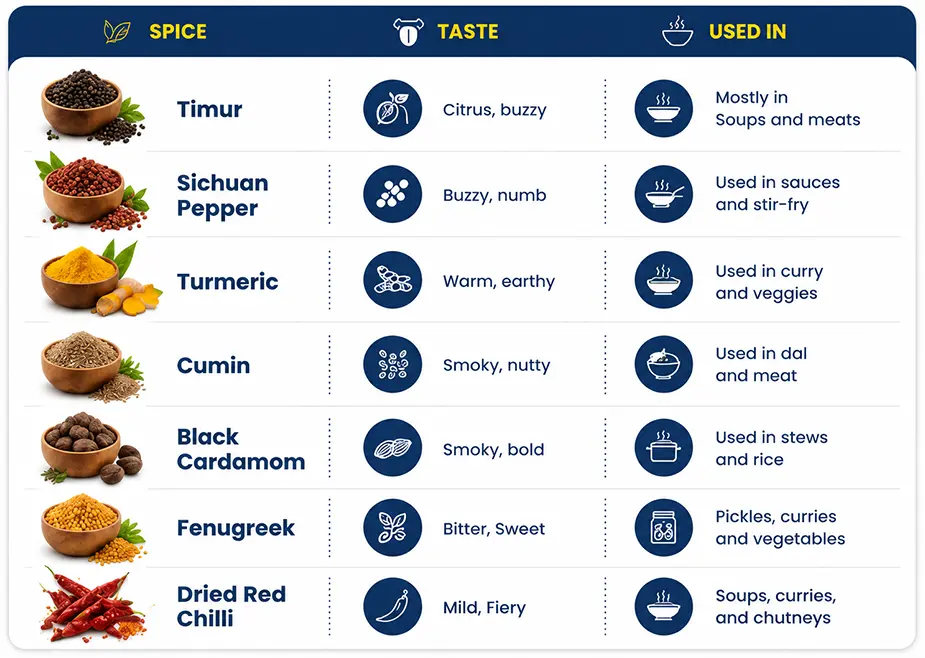
Here is a simple table for you, so you know which Himalayan spice tastes what and in what types of dishes they are used.
Many people think that Himalayan spices are all about adding heat, but if you ask anyone who grew up in the Himalayan region, they’ll tell you it was never just about heat. Himalayan spices do much more than add heat, they build flavors that shape the whole personality of a dish. Take away these spices from Himalayan food, and it will feel blunt.
But as mentioned earlier, it is not about which spice you’re using; it is about how you use it. Every Himalayan household has its own rules and style for using these spices, like how long to dry-roast the cumin before it starts to smell right. Whether the fenugreek goes first or last. How fine the black cardamom needs to be ground before it stops tasting sharp and starts tasting smoky.
There is no specific recipe book for cooking in Himalayan kitchens. Most of us just watch our mothers and grandmothers cook a dish a hundred times, and eventually one day we learn it too. This is probably the main reason why the same dal tastes completely different in two households. Same spices, same dal but totally different results. One kitchen's version might lean smoky and deep, others might come out brighter and sharper. Neither is wrong; it just depends which one you like.
So when people talk about Himalayan food being "rich" or "complex," they are not talking about spices, they just don’t know the technique used in spice blending. The turmeric, the cumin, the black cardamom- they matter, sure. But it's the hands that know what to do with them that actually make the food unforgettable.
Next time you're eating Himalayan or Indian food in Richardson, try to notice this. See if you can pick out the citrusy tingle of Timur, or the smoky depth of black cardamom sitting quietly in the background. Once you start noticing it, you can't really stop.
For thousands of years, spices have been used in Indian food for three main reasons: their flavor, their ability to preserve food longer, and their medicinal properties. Here in Richardson, Himalayan Corner has been providing real Himalayan flavor for over a decade. We are a small team, and all of us have one thing in common: we love good Himalayan food and always try to provide the same to our customers.
Want to try it? Check our full menu and order your favorite dish. We make sure you get the best Indian food in Richardson.
Order Himalayan Food in Richardson on Grubhub, Uber Eats, and DoorDash.
The history of spices is so old and rich that at one time people fought wars just for the spice trade. Fortunately, the spice trade has been decentralized now, and you can easily get whatever spice you want.
Himalayan spices have been a key ingredient for the better taste and aroma of Indian foods. Spices like Timur, Turmeric, and Sichuan not only enhance food flavor but also add medicinal properties that keep your gut healthy and help fight minor diseases. Still, as mentioned earlier, having the spice rack doesn’t mean you can get the real authentic Himalayan food.
Himalayan Corner has been offering real Himalayan food with authentic recipes and spices for over a decade in Richardson. You can also order at your doorstep.
Founded by Umesh Adhikari, Himalayan Corner brings true Indian and Himalayan flavors to Richardson. With years of experience in the food industry, Umesh combines traditional recipes, quality ingredients, and warm hospitality to create a memorable dining experience.